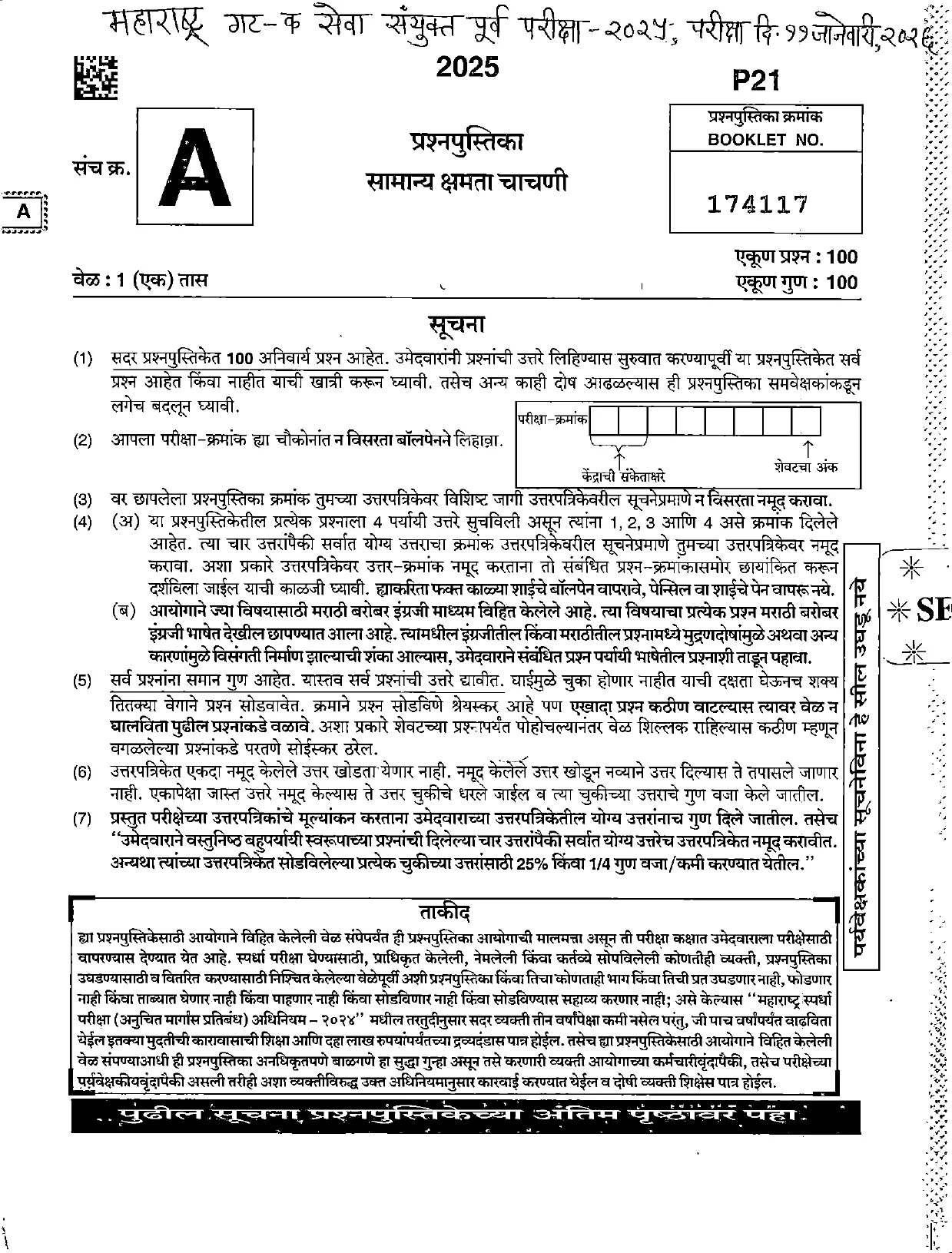
Below is the raw extracted text layer indexed from the official PDF for search accessibility, screen readers, and quick question search.
Maharashtra Public Service Commission Assessment
Duration :
Number of Questions :
Total Marks :
Display Marks:
Assistant Professor Forensic Science Group A Higher and
Technical Education Department
60
100
200
Yes
Maximum Instruction Time :
Is Section Default? :
0
No
Subject Name :
Question Number : 1 Question Id : 4410092132673 Question Type : MCQ
What is the primary purpose of maintaining a chain of custody in forensic science?
Options :
1. To positively identify suspects at a crime scene
2. To prevent and control access at the crime scene
3. To secure the crime scene from contamination
4. To ensure the integrity and traceability of evidence
Question Number : 2 Question Id : 4410092132667 Question Type : MCQ
What is the primary purpose of securing a crime scene during forensic investigations?
Options :
1. Supports routine media coverage during investigation
2. Facilitates immediate suspect apprehension procedures
3. Permits unrestricted public access during investigation
4. Prevents evidence contamination during investigation
�Question Number : 3 Question Id : 4410092132669 Question Type : MCQ
Which of the following is an example of a secondary crime scene?
Options :
1. A site where the victim's body is dumped
2. The room where the victim was assaulted
3. The bank where the robbery occurred
4. The location where the murder took place
Question Number : 4 Question Id : 4410092132670 Question Type : MCQ
Which of the following is the primary goal when securing a crime scene during forensic investigation?
Options :
1. To collect all evidence as quickly as possible
2. To allow public access to the area
3. To preserve the integrity of physical evidence
4. To arrest any suspects present at the scene
Question Number : 5 Question Id : 4410092132671 Question Type : MCQ
The recommendation that an investigator should touch the minimum possible surface area of an exhibit primarily aims to preserve:
Options :
1. Surface characteristics and physical appearance of the exhibit
2. Latent, biological, and trace evidence present on the exhibit
3. Chemical composition and physical properties of the exhibit
4. Structural integrity and overall condition of the exhibit
�Question Number : 6 Question Id : 4410092132678 Question Type : MCQ
A forensic scientist presents novel DNA analysis evidence, and the defense challenges its admissibility. What difference exists between the Frye
and Daubert standards for assessing the admissibility of scientific evidence?
Options :
1. Both legal standards employ identical criteria of general scientific acceptance and peer reviews
2. Frye relies on general acceptance, whereas Daubert evaluates scientific reliability and relevance
3. Frye examines known error rates, whereas Daubert strictly requires general scientific acceptance
4. Daubert relies primarily upon established judicial precedents rather than on scientific validity
Question Number : 7 Question Id : 4410092132680 Question Type : MCQ
What is the role of the Bharatiya Nagarik Suraksha Sanhita in the Indian criminal justice system?
Options :
1. Governs civil dispute proceedings between private parties
2. Prescribes specific conduct standards for police officers
3. Outlines procedures for criminal investigation and trials
4. Establishes statutory penalties for any criminal offences
Question Number : 8 Question Id : 4410092132682 Question Type : MCQ
How does the Bharatiya Sakshya Adhiniyam, 2023 promote a fair trial when electronic evidence is presented in criminal cases?
Options :
1. It presumes all electronic records are genuine.
2. It permits admission without verification.
3. It requires proof of authenticity and integrity.
4. It excludes all electronic evidence from being presented in court.
�Question Number : 9 Question Id : 4410092132683 Question Type : MCQ
A forensic expert provides a DNA analysis report in a criminal trial under the Bharatiya Sakshya Adhiniyam, 2023. Which factor is most
important for the court when assessing the evidentiary value of the expert opinion?
Options :
1. Whether the expert is employed by the investigating agency.
2. Whether the opinion is supported by accepted scientific principles.
3. Whether the opinion supports the prosecution's case or defence's case.
4. Whether the expert has testified in similar cases.
Question Number : 10 Question Id : 4410092132687 Question Type : MCQ
Which scenario best illustrates an ethical issue that may arise within Forensic Science Laboratories?
Options :
1. Implementation of professional training for all laboratory personnel.
2. The lab implements quality control procedures to ensure accurate test results.
3. Staff members are rotated between sections to minimize potential bias.
4. Altering examination findings to satisfy investigative expectations.
Question Number : 11 Question Id : 4410092132689 Question Type : MCQ
A series of dawn burglaries targets elderly victims living alone in a suburb; no physical evidence is left. Which approach helps narrow the suspect
pool?
Options :
1. Reviewing nationwide databases for similar modus operandi
2. Focusing on local offenders familiar with the victims' routines
3. Targeting individuals with violent criminal records in the region
4. Relying on forensic evidence collection at the crime scenes
�Question Number : 12 Question Id : 4410092132690 Question Type : MCQ
Which approach best demonstrates an evidence-based evaluation of the evidentiary value of a polygraph test?
Options :
1. Accept the polygraph as conclusive evidence of deception.
2. Assume physiological reactions are always due to anxiety in suspects.
3. Rely solely on experience of polygraph examiner for interpretation.
4. Assess test sensitivity, specificity, and alternative explanations.
Question Number : 13 Question Id : 4410092132679 Question Type : MCQ
What is the primary role of the Bharatiya Nyaya Sanhita in the Indian criminal justice system?
Options :
1. To regulate forensic science education curriculum
2. To define criminal offences and prescribe punishments
3. To lay down the procedure for criminal investigations
4. To exclusively govern the admissibility of forensic evidence
Question Number : 14 Question Id : 4410092132695 Question Type : MCQ
Which of the following generally requires medicolegal investigation?
Options :
1. Death due to age related ailments
2. Death due to chronic kidney disease
3. Death due to natural causes
4. Death due to unnatural causes
Question Number : 15 Question Id : 4410092132698 Question Type : MCQ
Which approach is used to distinguish homicidal poisoning from accidental poisoning in a forensic investigation?
Options :
1. Toxicological, autopsy, and investigative findings
2. Presence of poison in biological specimens alone
3. Age of the deceased and post-mortem interval
4. Colour and consistency of the recovered poison
�Question Number : 16 Question Id : 4410092132697 Question Type : MCQ
A forensic expert is evaluating an alleged sexual assault in which the accused claims prior consensual sexual contact. Which combination of
forensic examinations would provide the most useful evidence regarding the occurrence, source, and associated findings of the sexual contact?
Options :
1. Blood grouping, hormonal analysis, and injury assessment
2. Vaginal pH measurement, physical examination, and injury assessment
3. Injury documentation, seminal fluid examination and DNA profiling
4. Toxicological screening, blood grouping, and stain examination
Question Number : 17 Question Id : 4410092132701 Question Type : MCQ
A forensic scientist is examining a mineral sample suspected to be asbestos. Which feature of the polarizing microscope makes it most suitable for
distinguishing asbestos fibers from other similar materials in this scenario?
Options :
1. Reveal birefringence and optical orientation
2. Detect fluorescence from organic compounds
3. Produce high-resolution surface images
4. Enhance image contrast by phase shifting
Question Number : 18 Question Id : 4410092132703 Question Type : MCQ
A forensic laboratory analyzes an unknown white powder using a combination of UV-Visible and Infrared (IR) spectroscopy. Which statement
accurately describes the complementary information provided by these two techniques for compound characterization?
Options :
1. UV-Visible spectroscopy differentiates chromophores, while IR spectroscopy identifies molecular functional groups.
2. UV-Visible spectroscopy identifies functional groups, while IR spectroscopy determines elemental composition.
3. UV-Visible spectroscopy measures molecular vibrations, while IR spectroscopy detects electronic transitions.
4. UV-Visible spectroscopy determines molecular weight, while IR spectroscopy establishes isotopic abundance.
�Question Number : 19 Question Id : 4410092132704 Question Type : MCQ
A forensic analyst must compare two automotive paint samples. Which spectrophotometric technique provides rapid acquisition and high spectral
resolution through interferometric data acquisition?
Options :
1. Dispersive infrared spectrophotometry
2. Ultraviolet-visible spectrophotometry
3. Raman spectrophotometry
4. Fourier transform infrared spectrophotometry
Question Number : 20 Question Id : 4410092132708 Question Type : MCQ
Which statement best describes the advantage of reversed-phase HPLC in forensic toxicology?
Options :
1. Separates compounds based on molecular size and molecular mass.
2. Suitable only for ionic compounds.
3. Compatible with aqueous biological samples and diverse drugs.
4. Requires no separate sample preparation for blood analysis.
Question Number : 21 Question Id : 4410092132709 Question Type : MCQ
Which feature of high-performance thin-layer chromatography (HPTLC) supports its use for preliminary screening of multiple drug samples in
the chemistry laboratory?
Options :
1. Simultaneous separation and comparison of multiple samples on one plate
2. Separation of compounds based on molecular size with detection systems
3. Direct analysis of biological samples without prior sample preparation
4. Detection of compounds with sensitivity similar to advanced techniques
�Question Number : 22 Question Id : 4410092132707 Question Type : MCQ
A forensic scientist analyses a psychoactive substance in a biological sample using thin-layer chromatography (TLC). Which approach improves
chromatographic selectivity and resolution?
Options :
1. Increasing the thickness of the TLC plate
2. Optimizing the mobile phase composition
3. Increasing the duration of plate development
4. Increasing the volume of sample application
Question Number : 23 Question Id : 4410092132268 Question Type : MCQ
Which is the principal advantage of low-voltage electrophoresis over high-voltage electrophoresis?
Options :
1. It enhances the field strength to improve separation resolution
2. It increases analysis speed by accelerating the ionic migration
3. It improves separation by increasing electrophoretic mobilities
4. It reduces sample overheating and preserve biomolecule integrity
Question Number : 24 Question Id : 4410092132270 Question Type : MCQ
A forensic analyst examines a complex organic mixture from a crime scene. Which of the following provides compound separation and molecular
identification?
Options :
1. Ultraviolet spectroscopy with absorbance analysis
2. Gas chromatography with mass spectrometry
3. Gas chromatography with flame detection
4. Infrared spectroscopy with spectral analysis
�Question Number : 25 Question Id : 4410092132271 Question Type : MCQ
An analyst evaluates a complex biological sample for trace drug metabolites using Liquid Chromatography Tandem Mass Spectrometry (LCMS/MS). Which analytical strategy enhances detection sensitivity and specificity?
Options :
1. Utilizing multiple reaction monitoring with gradient elution
2. Deploying standard ultraviolet detection with high flow rates
3. Elevating source voltages with reduced injection volumes
4. Using isocratic elution with reversed-phase columns
Question Number : 26 Question Id : 4410092132275 Question Type : MCQ
Which of the following best describes the principle behind a competitive immunoassay used in forensic toxicology?
Options :
1. Enzyme-linked secondary antibody is used to detect the bound antigen in the sample
2. Antigen and antibody form a direct complex without competition in the reaction
3. Analyte in the sample competes with labeled analyte for a limited number of antibody binding sites
4. Fluorescence Polarization Immunoassay (FPIA) is used to separate bound and free antigen in the assay
Question Number : 27 Question Id : 4410092132278 Question Type : MCQ
What is the function of the EDX detector in the SEM-EDX system?
Options :
1. To detect backscattered electron signals
2. To produce accelerated electron beams
3. To measure characteristic X-ray energies
4. To control motorized specimen platforms
�Question Number : 28 Question Id : 4410092132281 Question Type : MCQ
What is the purpose of maintaining a high vacuum in the specimen chamber during SEM‑EDX analysis?
Options :
1. To cool the detector assembly
2. To increase X-ray production
3. To reduce electron scattering
4. To improve sample conductivity
Question Number : 29 Question Id : 4410092132284 Question Type : MCQ
Which property of atomic nuclei is primarily exploited in Nuclear Magnetic Resonance (NMR) Spectroscopy for forensic analysis?
Options :
1. Nuclear spin
2. Atomic radius
3. Magnetic susceptibility
4. Electron affinity
Question Number : 30 Question Id : 4410092132286 Question Type : MCQ
Microscopic examination of a suspected bloodstain reveals brown rhombic crystals after heating with glacial acetic acid and sodium chloride.
Which confirmatory test produces this result?
Options :
1. Teichmann crystal test
2. Takayama crystal test
3. Lattes crust test
4. Absorption–inhibition test
�Question Number : 31 Question Id : 4410092132287 Question Type : MCQ
A forensic blood sample agglutinates with anti-A and anti-B antisera but not with anti-D antiserum. What is its blood group?
Options :
1. AB positive
2. O negative
3. AB negative
4. O positive
Question Number : 32 Question Id : 4410092132289 Question Type : MCQ
A stain shows a positive acid phosphatase test but no spermatozoa on microscopy. Which additional test supports the presence of seminal fluid?
Options :
1. Repeat acid phosphatase testing
2. Detect vaginal epithelial cells
3. Detect blood group substances
4. Detect prostate-specific antigen
Question Number : 33 Question Id : 4410092132290 Question Type : MCQ
Vaginal epithelial cells are characterized by:
Options :
1. Anucleate fragments with granules
2. Polygonal shape with high glycogen
3. Segmented nuclei and granular cytoplasm
4. Elongated bodies with flagella
�Question Number : 34 Question Id : 4410092132295 Question Type : MCQ
Which DNA profiling technique is widely used in forensic science for identifying individuals based on variations in specific regions of the
genome?
Options :
1. Polymerase Chain Reaction (PCR)
2. Short Tandem Repeat (STR) analysis
3. Gene expression analysis
4. Mitochondrial DNA analysis
Question Number : 35 Question Id : 4410092132296 Question Type : MCQ
Which characteristic of short tandem repeat (STR) loci provides high discriminatory power in forensic DNA profiling?
Options :
1. Low mutation rate
2. Identical alleles across individuals
3. High repeat number variability
4. Exclusive sex chromosome location
Question Number : 36 Question Id : 4410092132297 Question Type : MCQ
A forensic DNA profile generated from a low-template sample shows inconsistent allele detection on replicate amplification. This finding is
characteristic of:
Options :
1. Stutter formation
2. Null alleles
3. Linkage disequilibrium
4. Allelic dropout
�Question Number : 37 Question Id : 4410092132302 Question Type : MCQ
Which genetic marker panel is routinely used to resolve parentage disputes in forensic investigations?
Options :
1. Multiple short tandem repeat loci
2. Multiple ABO blood group markers
3. Single short tandem repeat locus
4. Mitochondrial DNA markers only
Question Number : 38 Question Id : 4410092132305 Question Type : MCQ
A confiscated wildlife specimen consists of dried tissue without identifiable morphological features. Which laboratory approach is routinely used
for species identification?
Options :
1. ABO blood group testing
2. DNA barcode region sequencing
3. Human leukocyte antigen typing
4. Y-chromosome STR analysis
Question Number : 39 Question Id : 4410092132308 Question Type : MCQ
Which body fluid is in direct equilibrium with the ethanol measured in alveolar breath?
Options :
1. Saliva
2. Gastric Content
3. Blood
4. Urine
�Question Number : 40 Question Id : 4410092132311 Question Type : MCQ
The initial oxidation of methanol in the liver is catalyzed by:
Options :
1. Catalase
2. Cytochrome oxidase
3. Acetylcholinesterase
4. Alcohol dehydrogenase
Question Number : 41 Question Id : 4410092132314 Question Type : MCQ
A control hand-wash remains colourless, whereas the post-trap hand-wash turns pink. This comparison demonstrates:
Options :
1. Transfer of sodium carbonate during the operation
2. Presence of fingerprints on the currency
3. Transfer of phenolphthalein during the operation
4. Exchange of perspiration between individuals
Question Number : 42 Question Id : 4410092132331 Question Type : MCQ
Hydride generation atomic absorption spectrometry is particularly suitable for the analysis of:
Options :
1. Arsenic and antimony
2. Mercury and chromium
3. Nickel and manganese
4. Cadmium and lead
�Question Number : 43 Question Id : 4410092132321 Question Type : MCQ
Acute Food poisoning caused by heavy metal contamination commonly presents with which clinical feature(s)?
Options :
1. Acute nausea, vomiting, and abdominal pain
2. Persistent fever, watery diarrhea, and dehydration
3. Progressive cough, wheezing, and chest discomfort
4. Generalized rash, itching, and joint stiffness
Question Number : 44 Question Id : 4410092132322 Question Type : MCQ
Which preliminary colour test is based on the formation of a cobalt–barbiturate coordination complex?
Options :
1. Marquis test
2. Scott test
3. Duquenois–Levine test
4. Dille-Koppanyi test
Question Number : 45 Question Id : 4410092132323 Question Type : MCQ
Which preliminary screening technique can separate and presumptively differentiate morphine, codeine, and heroin in a seized drug sample?
Options :
1. Thin Layer Chromatography
2. Colorimetric spot tests
3. Immunoassay screening
4. Gas Chromatography-Mass Spectrometry
�Question Number : 46 Question Id : 4410092132328 Question Type : MCQ
A patient develops perioral numbness, rapidly progressive paralysis, and respiratory failure shortly after consuming seafood. Which of the
following is the most likely source of the toxin?
Options :
1. King crab
2. Pomfret
3. Mackerel
4. Puffer fish
Question Number : 47 Question Id : 4410092132330 Question Type : MCQ
Mercury incorporated into growing hair primarily reflects:
Options :
1. Acute exposure
2. Recent exposure
3. Chronic exposure
4. Postmortem redistribution
Question Number : 48 Question Id : 4410092132329 Question Type : MCQ
The principal advantage of inductively coupled plasma–mass spectrometry (ICP–MS) in forensic toxicology is its ability to:
Options :
1. Determine molecular structures with high sensitivity
2. Separate volatile compounds with high sensitivity
3. Identify functional groups with high sensitivity
4. Quantify trace elements with high sensitivity
�Question Number : 49 Question Id : 4410092132319 Question Type : MCQ
A fat‑soluble pesticide is suspected. Which property of the pesticide guides the selection of adipose tissue as the biological matrix for analysis?
Options :
1. Route of exposure to the pesticide
2. The quantity of the pesticide
3. Physicochemical properties of the biological specimen
4. Toxicokinetic properties of the pesticide
Question Number : 50 Question Id : 4410092132327 Question Type : MCQ
A patient presents with ptosis, blurred vision, descending paralysis, and respiratory failure following an unrecognized nocturnal bite with minimal
local swelling. Which poisonous animal is the likely cause?
Options :
1. Black widow spider
2. Indian red scorpion
3. Russell's viper
4. Common krait
Question Number : 51 Question Id : 4410092132185 Question Type : MCQ
Which reagent is used to detect lead residues around a bullet hole during forensic examination?
Options :
1. Dithiooxamide reagent
2. Modified Griess reagent
3. Diphenylamine reagent
4. Sodium rhodizonate
�Question Number : 52 Question Id : 4410092132186 Question Type : MCQ
Which metric quantifies a projectile's ability to resist deceleration from air resistance and maintain velocity during flight?
Options :
1. Sectional density
2. Drag coefficient
3. Ballistic coefficient
4. Form factor
Question Number : 53 Question Id : 4410092132184 Question Type : MCQ
A rim-fire cartridge case ruptures at the rim during firing. Which of the following explains this failure?
Options :
1. The propellant used in rim-fire ammunition burns at a higher temperature
2. The rim must be thin for firing-pin ignition, reducing structural strength
3. The absence of a flash hole prevents pressure relief during firing
4. The priming compound increases chamber pressure during ignition
Question Number : 54 Question Id : 4410092132193 Question Type : MCQ
A country-made pistol produces bullets with inconsistent striations across multiple test firings, with no reproducible pattern observed. How should
the forensic examiner interpret these marks?
Options :
1. They are individual characteristics of the barrel
2. They are insufficient for individualisation
3. They are class characteristics of the firearm
4. They are subclass characteristics from tooling
�Question Number : 55 Question Id : 4410092132197 Question Type : MCQ
Which term describes the slow conical motion of a projectile's longitudinal axis about its flight path?
Options :
1. Trajectory
2. Dispersion
3. Deflection
4. Precession
Question Number : 56 Question Id : 4410092132201 Question Type : MCQ
A projectile produces a larger temporary cavity in soft tissue than another projectile of similar design. Which factor explains this difference?
Options :
1. Greater projectile density
2. Greater projectile length
3. Greater projectile diameter
4. Greater kinetic energy transfer
Question Number : 57 Question Id : 4410092132199 Question Type : MCQ
Two bullets of identical calibre and muzzle velocity are fired under identical conditions. Bullet A has a higher ballistic coefficient than Bullet B.
Which outcome occurs at long range?
Options :
1. Bullet A exhibits increased trajectory curvature
2. Bullet A experiences greater aerodynamic drag
3. Bullet A undergoes reduced rotational stability
4. Bullet A retains velocity more effectively
�Question Number : 58 Question Id : 4410092132204 Question Type : MCQ
A screwdriver recovered from a suspect produces striated marks that match a questioned tool mark in pattern and sequence. Which characteristic
supports individualization?
Options :
1. Common dimensions of the screwdriver tip
2. Reproducible microscopic surface irregularities
3. General shape of the impressed mark
4. Manufacturer-specific design features
Question Number : 59 Question Id : 4410092132205 Question Type : MCQ
A serial number ground off a firearm frame is partially restored with chemical etching, but some digits remain illegible. What primary physical
factor limits complete restoration?
Options :
1. Chemical composition of etching reagent
2. Original force applied during stamping
3. Depth of the plastic deformation zone
4. Overall thickness of the metallic frame
Question Number : 60 Question Id : 4410092132209 Question Type : MCQ
Which of the following is classified as a light petroleum distillate in fire debris analysis?
Options :
1. Gasoline
2. Lubricating oil
3. Kerosene
4. Diesel
�Question Number : 61 Question Id : 4410092132212 Question Type : MCQ
A fire debris sample shows a preferential loss of lighter hydrocarbons compared to a fresh gasoline reference. Which physical process explains
this chromatographic pattern?
Options :
1. Differential evaporation
2. Substrate pyrolysis
3. Incomplete combustion
4. Differential diffusion
Question Number : 62 Question Id : 4410092132215 Question Type : MCQ
Post‑blast examination reveals negligible soot deposition, indicating nearly complete oxidation of the explosive products. Which explosive
property explains this observation?
Options :
1. Positive oxygen balance
2. High sensitivity to initiation
3. Low critical diameter
4. High detonation velocity
Question Number : 63 Question Id : 4410092132217 Question Type : MCQ
Which type of container is used to collect fire debris suspected of containing ignitable liquid residues?
Options :
1. Paper evidence envelopes
2. Polyethylene plastic bags
3. Unlined metal paint cans
4. Cardboard collection boxes
�Question Number : 64 Question Id : 4410092132221 Question Type : MCQ
Why are soil samples recovered from a fire scene refrigerated or frozen before laboratory analysis?
Options :
1. To accelerate evaporation of volatile residues
2. To solidify petroleum residues for easier handling
3. To halt microbial degradation of hydrocarbons
4. To separate water from insoluble accelerants
Question Number : 65 Question Id : 4410092132224 Question Type : MCQ
Which photographic lighting technique is used to visualize indented writing on a questioned document?
Options :
1. Coaxial lighting
2. Oblique lighting
3. Diffused lighting
4. Transmitted lighting
Question Number : 66 Question Id : 4410092132240 Question Type : MCQ
An intact multi-layer automotive paint chip requires elemental profiling of a single internal microscopic layer. Which technique achieves this
without physically separating the strata?
Options :
1. Energy dispersive X-ray spectroscopy
2. Inductively coupled plasma spectrometry
3. Fourier transform infrared spectroscopy
4. Ultraviolet visible absorption spectroscopy
�Question Number : 67 Question Id : 4410092132241 Question Type : MCQ
A questioned brick fragment and a reference sample have matching elemental profiles by X-ray fluorescence. Which technique can distinguish
them based on crystalline phase composition?
Options :
1. X‑ray diffraction (XRD)
2. Inductively coupled plasma mass spectrometry (ICP‑MS)
3. Fourier transform infrared spectroscopy (FTIR)
4. Scanning electron microscopy (SEM)
Question Number : 68 Question Id : 4410092132232 Question Type : MCQ
In forensic pollen and diatom examinations, photography is used to:
Options :
1. Measure chemical composition
2. Determine DNA sequences
3. Identify species by colour
4. Record morphological features
Question Number : 69 Question Id : 4410092132235 Question Type : MCQ
Two soil samples show identical elemental profiles by X-ray fluorescence. Which technique can differentiate the crystal structures of their clay
minerals?
Options :
1. Atomic absorption spectrometry
2. Neutron activation analysis
3. Scanning electron microscopy
4. X-ray powder diffraction
�Question Number : 70 Question Id : 4410092132239 Question Type : MCQ
Why is pyrolysis gas chromatography-mass spectrometry (Py-GC-MS) used in forensic paint analysis?
Options :
1. To determine pigment colour composition directly
2. To identify organic binders and additives
3. To measure paint hardness and durability
4. To measure the thickness of paint layers
Question Number : 71 Question Id : 4410092132231 Question Type : MCQ
A questioned hair has a lattice medulla and a medullary index of 0.8. A known dog hair has a mosaic medulla and a medullary index of 0.5. The
questioned hair is:
Options :
1. Consistent with the known dog hair
2. Inconsistent with the known dog hair
3. Consistent with human body hair
4. Consistent with human pubic hair
Question Number : 72 Question Id : 4410092132245 Question Type : MCQ
A smartphone seized at a scene has an active cellular connection and an unlocked screen. Which action should be taken to prevent a remote wipe
before forensic imaging?
Options :
1. Power down the device before examination
2. Remove the SIM card before acquisition
3. Isolate the device from all wireless networks
4. Enable network synchronization services
�Question Number : 73 Question Id : 4410092132246 Question Type : MCQ
During the seizure of an active computer, investigators determine that the disk uses full-disk encryption. Which procedure preserves the
information required to access the encrypted data?
Options :
1. Capturing the active volatile memory
2. Cloning the encrypted storage volume
3. Extracting the physical storage drive
4. Initiating an immediate system shutdown
Question Number : 74 Question Id : 4410092132249 Question Type : MCQ
In a session hijacking attack, how does an adversary gain unauthorized access to an authenticated user session?
Options :
1. Injecting malicious relational database queries
2. Deciphering encrypted user login passwords
3. Exploiting unpatched system software flaws
4. Intercepting active web session cookies
Question Number : 75 Question Id : 4410092132252 Question Type : MCQ
A memory analyst identifies an executing process within a RAM dump that does not appear in the operating system's standard process
enumeration list. Which technique creates this specific discrepancy?
Options :
1. Direct kernel object manipulation
2. Master boot record modification
3. Alternate data stream execution
4. Dynamic link library injection
�Question Number : 76 Question Id : 4410092132368 Question Type : MCQ
Which of the following best describes a chance print in the context of forensic dermatoglyphics?
Options :
1. A print created deliberately for identification
2. A clearly visible impression made using ink
3. A fingerprint made by artificial means in a laboratory
4. An unintentional fingerprint left at a crime scene
Question Number : 77 Question Id : 4410092132372 Question Type : MCQ
In an AFIS workflow, what is the main function of the matching algorithm during fingerprint identification?
Options :
1. Extracting minutiae points
2. Storing fingerprint templates
3. Capturing fingerprint images
4. Comparing biometric templates
Question Number : 78 Question Id : 4410092132373 Question Type : MCQ
An investigator receives a list of potential matches from Automated Fingerprint Identification System (AFIS). What is the next critical step to
ensure the reliability of the identification process?
Options :
1. The system output is automatically accepted as conclusive
2. All non-matching results are immediately discarded
3. The list is submitted as evidence without further review
4. A trained examiner validates the AFIS identification
�Question Number : 79 Question Id : 4410092132376 Question Type : MCQ
Which tyre characteristic is primarily used to associate a tyre impression with a particular tyre type or class?
Options :
1. Tread pattern
2. Tyre width
3. Air pressure
4. Rubber hardness
Question Number : 80 Question Id : 4410092132379 Question Type : MCQ
Which combination of track mark features is most useful for identifying gait abnormalities?
Options :
1. Irregular stride length and inconsistent foot angle
2. Uniform shoe tread and straight walking line
3. Narrow foot width and shallow prints
4. Symmetrical heel depth and regular toe spacing
Question Number : 81 Question Id : 4410092132382 Question Type : MCQ
In a population-wide forensic application, which challenge must be addressed to ensure fair and unbiased biometric identification?
Options :
1. Ensuring all users consent to biometric data collection
2. Implementing secure storage for biometric data templates
3. Encrypting all transmitted biometric information
4. Mitigating demographic bias in recognition algorithms
�Question Number : 82 Question Id : 4410092132383 Question Type : MCQ
In a high-security government facility, which access-control configuration provides the greatest protection against tailgating while maintaining
high biometric verification accuracy?
Options :
1. Iris recognition integrated with an interlocking turnstile system
2. Facial recognition integrated with standard electronic door locks
3. Fingerprint recognition controlling electromagnetic door locks
4. Contactless palm recognition with automatic sliding doors
Question Number : 83 Question Id : 4410092132385 Question Type : MCQ
Which of the following statements best describes a limitation of voice spectrometry in forensic cases?
Options :
1. It cannot analyze digital audio recordings
2. It requires a live speaker during analysis
3. It is primarily used for DNA profiling
4. Noise obscures critical speech features
Question Number : 84 Question Id : 4410092132388 Question Type : MCQ
Which acoustic parameter is most critical in distinguishing between two speakers with similar pitch but different vocal tract shapes in forensic
voice analysis?
Options :
1. Formant frequencies
2. Temporal modulation
3. Amplitude variations
4. Pitch frequency
�Question Number : 85 Question Id : 4410092132391 Question Type : MCQ
During the preliminary examination of a questioned document, which aspect is typically assessed before detailed instrumental analysis?
Options :
1. Text content for meaning and intent
2. Suspected alterations or erasures
3. Physical features such as paper and ink
4. The age of the questioned document
Question Number : 86 Question Id : 4410092132396 Question Type : MCQ
Which method is most suitable for detecting chemical erasures in a questioned document during forensic examination?
Options :
1. Application of ultraviolet light to reveal altered areas
2. Iodine fuming to visualize latent fingerprints
3. Infrared photography to detect carbon-based inks
4. Use of transmitted light to show indented impressions
Question Number : 87 Question Id : 4410092132393 Question Type : MCQ
In forensic document examination, why is scale placement critical in photographic reproduction of questioned documents?
Options :
1. It prevents image distortion from camera angle
2. It maintains color fidelity during reproduction
3. It determines the sequence of image capture
4. It preserves dimensional accuracy in reproduction
Question Number : 88 Question Id : 4410092132400 Question Type : MCQ
Which of the following techniques best preserves the charred documents for subsequent forensic analysis?
Options :
1. Freezing in dry ice
2. Encapsulation between glass plates
3. Applying adhesive tape to the document
4. Blotting with filter paper
�Question Number : 89 Question Id : 4410092132403 Question Type : MCQ
Which scientific technique is most suitable for detecting indented writing impressions on a questioned document without causing damage?
Options :
1. Electrostatic Detection Apparatus (ESDA)
2. Thin Layer Chromatography (TLC)
3. Video Spectral Comparator (VSC)
4. Infrared (IR) Spectroscopy
Question Number : 90 Question Id : 4410092132405 Question Type : MCQ
In forensic handwriting identification, why is the examination of connecting strokes between letters significant?
Options :
1. It identifies the paper source
2. It reveals individual writing habits
3. It detects ink forgeries
4. It analyzes chemical composition of paper
Question Number : 91 Question Id : 4410092132406 Question Type : MCQ
In the evaluation of questioned signatures, what does the presence of tremor and irregular line quality most often indicate?
Options :
1. Genuine signature executed quickly.
2. Normal variation due to writing speed.
3. Possible simulation or disguise by the writer.
4. Issues with ink transfer causing interruptions.
�Question Number : 92 Question Id : 4410092132412 Question Type : MCQ
Which of the following is the primary objective of conducting a post mortem examination in forensic medicine?
Options :
1. To collect trace evidence from the scene
2. To determine the cause and manner of death
3. To identify the time of death only
4. To certify the death without investigation
Question Number : 93 Question Id : 4410092132415 Question Type : MCQ
Which advantage of Virtopsy most directly contributes to preserving forensic evidence compared with a conventional autopsy?
Options :
1. Minimizing examiner fatigue during analysis
2. Preservation of body without destruction dissection
3. Elimination of toxicological examination
4. Prevention of post-mortem decomposition
Question Number : 94 Question Id : 4410092132418 Question Type : MCQ
Which characteristic best distinguishes a sharp force injury from a blunt force injury during forensic examination?
Options :
1. Wound edges that are undermined and irregular
2. Evidence of tissue bridging at the base of the wound
3. Wound margins that are abraded and bruised
4. Presence of clean, well-defined wound edges
Question Number : 95 Question Id : 4410092132419 Question Type : MCQ
Which characteristic most reliably distinguishes an incised wound from a stab wound in forensic analysis?
Options :
1. Wider tissue bridging at wound margins
2. Presence of ectopic bruise
3. Irregular wound edges with tissue crushing
4. Surface length exceeds tissue depth
�Question Number : 96 Question Id : 4410092132424 Question Type : MCQ
To minimize contamination and maximize evidentiary value, which sequence is generally recommended for collecting trace evidence from the
body of a sexual offence survivor?
Options :
1. Collect pubic hair combings first, then remove clothing, and finally swab external genitalia
2. Swab external genitalia first, then collect clothing, and finally collect pubic hair combings
3. Remove clothing, then swab internal genitalia, and finally collect pubic hair combings
4. Collect clothing first, then collect pubic hair combings, and finally swab external genitalia
Question Number : 97 Question Id : 4410092132427 Question Type : MCQ
Which process is least reliable for age estimation in elderly individuals during forensic analysis?
Options :
1. Cranial suture closure
2. Pubic symphysis degeneration
3. Degree of tooth wear
4. Tooth eruption pattern
Question Number : 98 Question Id : 4410092132431 Question Type : MCQ
In forensic skull superimposition, what is a limitation when using photographs of living individuals for comparison?
Options :
1. Advanced software compatibility issues
2. High-resolution imaging limitations
3. Differences in facial expressions and head posture
4. Variation in clothing worn by subjects
�Question Number : 99 Question Id : 4410092132432 Question Type : MCQ
When performing skull-photo superimposition, which anatomical alignment is primarily used to achieve accurate registration between the skull
and the photograph?
Options :
1. Matching the cranial base with the top of the head in the photograph
2. Aligning the angle of the mandible with the jawline in the image
3. Positioning the orbits and nasal aperture in the same plane as the photograph
4. Aligning the external occipital protuberance with the scalp outline
Question Number : 100 Question Id : 4410092132436 Question Type : MCQ
Which environmental factor is incorporated into accumulated degree-hour (ADH) and accumulated degree-day (ADD) calculations for estimating
the postmortem interval using insect development?
Options :
1. Wind speed at the scene
2. Humidity levels at the scene
3. Temperature fluctuations at the scene
4. Soil pH surrounding the body
�