Below is the raw extracted text layer indexed from the official PDF for search accessibility, screen readers, and quick question search.
महाराष्ट्र वन सेवा मुख्य परीक्षा
-
दि. 5 ले 9 में, 2026
2025
2025
124
BOOKLET NO.
101056
Forest Services
Chemical Engineering
Time Allowed : Three Hours
Maximum Marks: 200
Type of Paper: Conventional/Descriptive
Medium: English
Question Paper Specific Instructions
Please read each of the following instructions carefully before attempting questions :
1.
There are EIGHT questions divided in two Sections, out of which FIVE are to be
attempted.
2.
Question No. 1 and 5 are compulsory. Out of the remaining questions, THREE are to
*SE
be attempted choosing at least ONE question from each Section.
3.
The number of marks carried by a question/sub-question is indicated against it.
4.
Keep in mind the word limit indicated in the question if any.
5.
Wherever option has been given, only the required number of responses in the serial order attempted
*
shall be assessed. Unless struck off, attempt of a question shall be counted even if attempted partly.
Excess responses shall not be assessed and shall be ignored.
6.
*
Candidates are expected to answer all the sub-questions of a question together. If sub-question of a
question is attempted elsewhere (after leaving a few page or after attempting another question) the
later sub-question shall be overlooked.
7.
Any page or portion of the page left blank in the Answer Booklet must be clearly struck off.
8.
Unless otherwise mentioned, symbol and notation have their usual standard meanings. Assume suitable
data, if necessary and indicate the same clearly.
9.
Neat sketches may be drawn, wherever required.
10.
The medium of answer should be mentioned on the answer book as claimed in the application and
printed on admission card. The answers written in medium other than the authorized medium will not
be assessed and no marks will be assigned to them.
Note: Candidates will be allowed to use Scientific (Non-programmable type) calculators.
P.T.O.
�124
2
SECTION -A
Q1.
Solve any five out of seven :
Q1.
(a) I) What is difference between dynamic and kinematic viscosity ?
(8×5=40)
8
II) Give the list of flow meters used in chemical industry.
III) State the significance of Reynold's number.
IV) Define compressible and incompressible flow with Mach number.
Q1.
(b) I) State the significance of relative volatility.
8
II) State whether the following is true or false.
i) Drying is the process of removing physical water (moisture) from clay through
evaporation.
ii)
Crystallization is used to purify liquids.
III) State the steps involved in simple distillation.
IV) Is the fractional distillation able to completely separate the mixture?
Q1.
(c) I) State the commonly used analogies between heat and momentum transfer and it's use.
8
II) Show that, Nusselt number is dimensionless.
III) Why emissivity of a black body is 1?
IV) Compare natural and forced convection in short.
Q1.
(d) I) State the names of common vessel support.
8
II) What is a role of size and capacity of vessel in determining its cost?
III) List out the commonly used materials in the construction of chemical plant.
IV) What is a 2: 1 elliptical head?
Q1.
(e) I) Define Fick's first law of diffusion.
II) State the four factors affecting diffusion.
III) What is absolute humidity (H)?
IV)
Define mass transfer coefficient (Kc).
8
�124
3
Q1. (f) I) State the mathematical expression for Fourier's law of heat conduction.
8
II) Define thermal conductivity and its SI unit.
III) Draw a schematic of i) Filmwise condensation and ii) Dropwise condensation.
IV) State the condition at which Emissivity is equal to absorptivity of material and also
mention the law related to it.
Q1.
(g) I) What are four key design components in a vertical storage vessel?
8
II) State the three pressure vessel design guidelines used to design to pressure vessel.
III) What is fixed operating cost and variable operating cost?
IV) Why flat heads required greater thickness and weight compared to curved heads?
(7.5×2=15)
Q2.
(a) I) Calculate the pressure in the hose whose absolute pressure is 1.01 x 10⁵ N/m², if the
speed of water in the hose increases from 1.96 m.s.¹ to 25.5 m.s.1.. Assume that the
flow is frictionless and density of water is 1.000 g/c.c. (1.0 g/c.c.).
II) Derive Bernoulli's equation. Draw a neat sketch and label it.
(7.5×2=15)
Q2.
(b) I) Explain Rotary drum filter with neat diagram.
II) Derive an empirical Henry Darcy's equation for the loss of pressure or head loss due
to
friction along the given length pipe to the average velocity of the fluid. Assume
incompressible fluid.
(5×2=10)
Q2.
(c) 1) State and explain key material of construction criterias applied in pressure vessel.
II) Write down the formulas for
a)
Dead weight stress (o
b) Bending stress () for vertical vessel skirt support.
P.T.O.
�124
4
(7.5×2=15)
Q3.
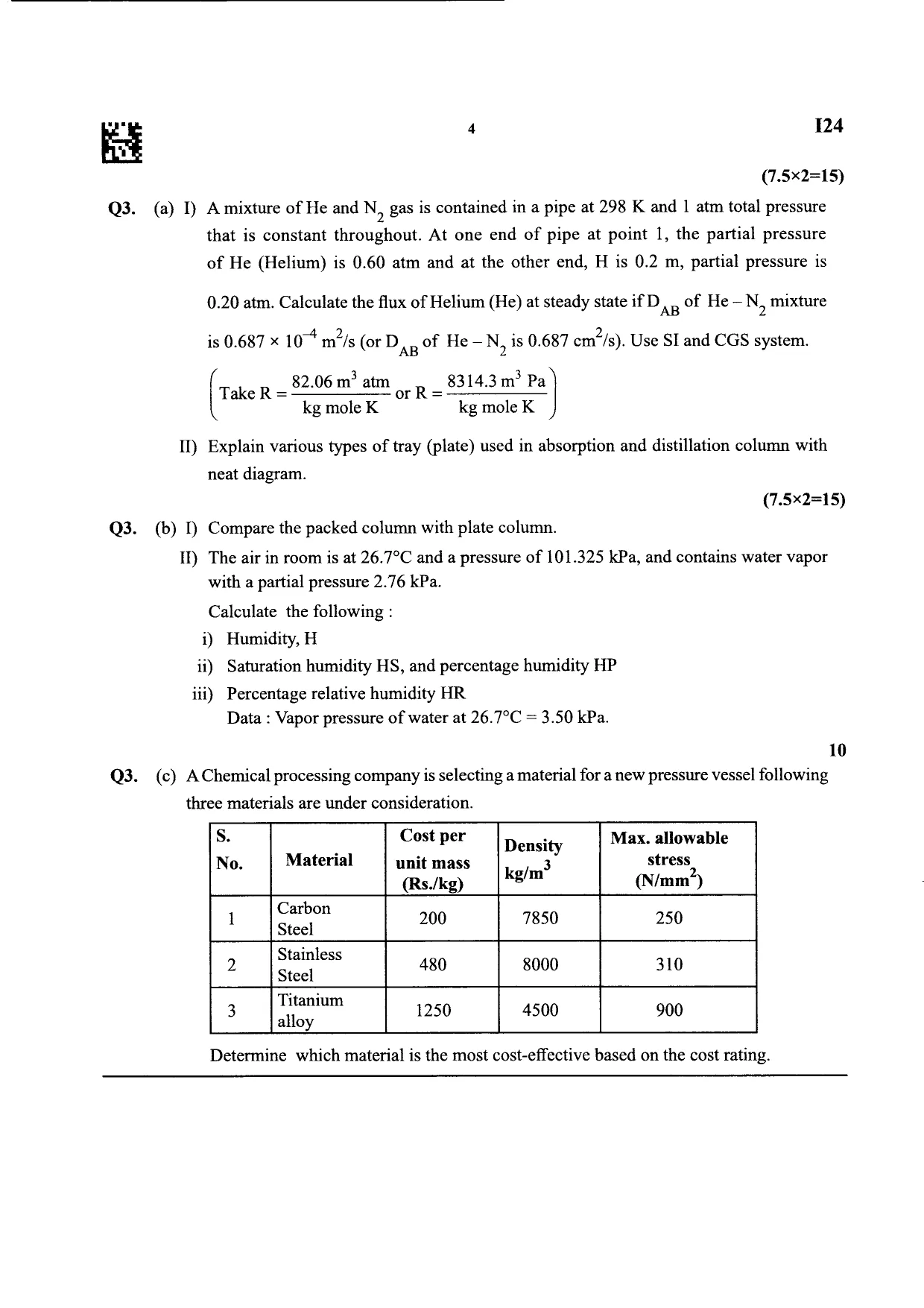
(a) I) A mixture of He and N, gas is contained in a pipe at 298 K and 1 atm total pressure
that is constant throughout. At one end of pipe at point 1, the partial pressure
of He (Helium) is 0.60 atm and at the other end, H is 0.2 m, partial pressure is
0.20 atm. Calculate the flux of Helium (He) at steady state if DAB of He -N₂ mixtu
m²/s (or DAn of He -N₂ is 0.687 cm²/s). Use SI and CGS system.
is 0.687 × 10
Take R=
82.06 m³ atm
kg mole K
or R
8314.3 m³ Pa
kg mole K
II) Explain various types of tray (plate) used in absorption and distillation column with
neat diagram.
(7.5×2=15)
Q3.
(b) I) Compare the packed column with plate column.
II) The air in room is at 26.7°C and a pressure of 101.325 kPa, and contains water vapor
with a partial pressure 2.76 kPa.
Calculate the following :
i) Humidity, H
ii)
Saturation humidity HS, and percentage humidity HP
iii) Percentage relative humidity HR
Data: Vapor pressure of water at 26.7°C = 3.50 kPa.
10
Q3.
(c) A Chemical processing company is selecting a material for a new pressure vessel following
three materials are under consideration.
S.
No.
Cost per
Material
unit mass
(Rs./kg)
1
2
3
Carbon
Steel
Stainless
Steel
Titanium
alloy
Density
kg/m³
Max. allowable
stress
(N/mm²)
200
7850
250
480
8000
310
1250
4500
900
Determine which material is the most cost-effective based on the cost rating.
�5
124
(7.5×2=15)
Q4.
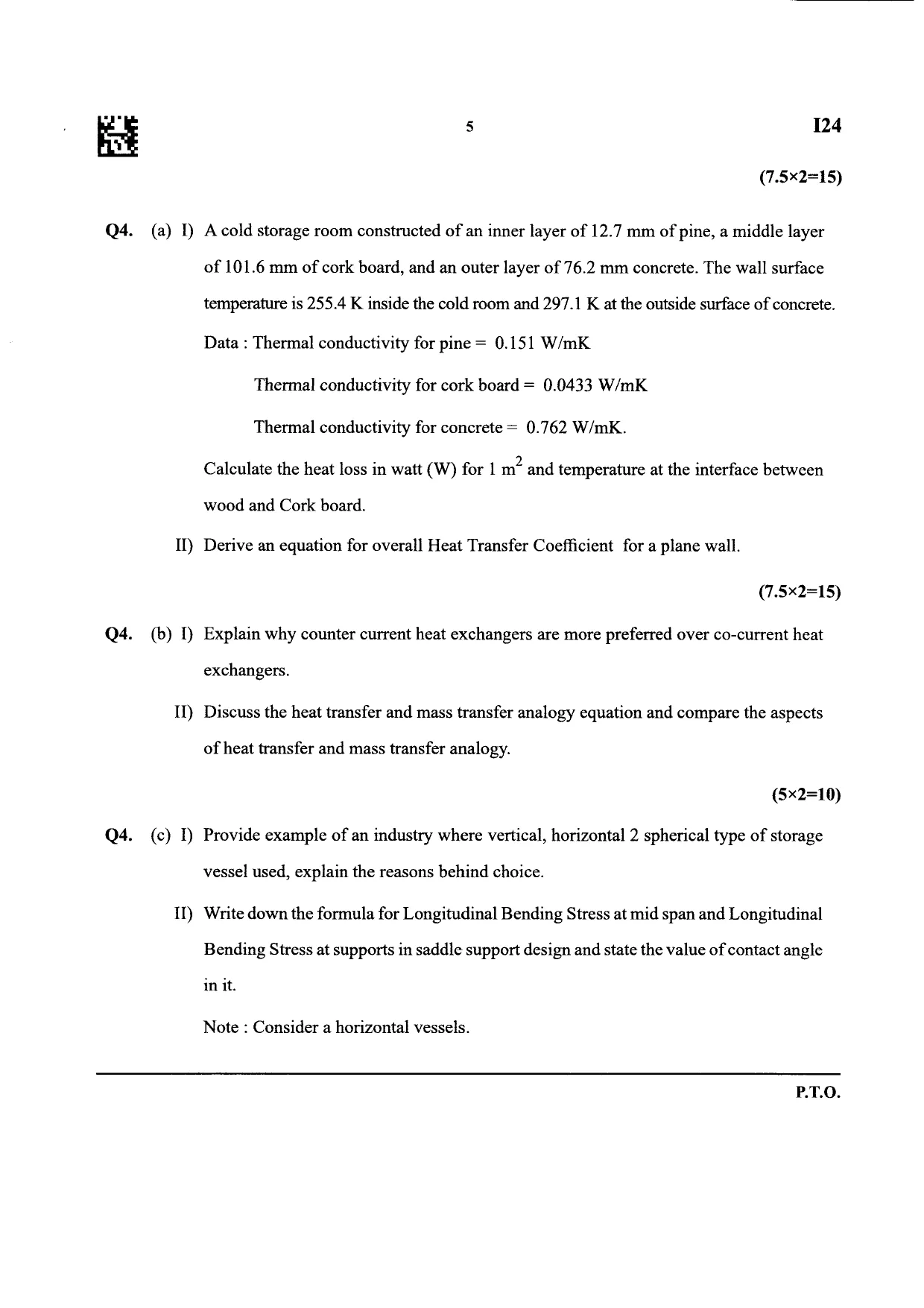
(a) I) A cold storage room constructed of an inner layer of 12.7 mm of pine, a middle layer
of 101.6 mm of cork board, and an outer layer of 76.2 mm concrete. The wall surface
temperature is 255.4 K inside the cold room and 297.1 K at the outside surface of concrete.
Data: Thermal conductivity for pine = 0.151 W/mK
Thermal conductivity for cork board = 0.0433 W/mK
Thermal conductivity for concrete = 0.762 W/mK.
m
and temperature at the interface between
Calculate the heat loss in watt (W) for 11 m
wood and Cork board.
II) Derive an equation for overall Heat Transfer Coefficient for aplane wall.
(7.5×2=15)
Q4.
(b) I) Explain why counter current heat exchangers are more preferred over co-current heat
exchangers.
II) Discuss the heat transfer and mass transfer analogy equation and compare the aspects
of heat transfer and mass transfer analogy.
(5×2=10)
Q4.
(c) I) Provide example of an industry where vertical, horizontal 2 spherical type of storage
vessel used, explain the reasons behind choice.
II) Write down the formula for Longitudinal Bending Stress at mid span and Longitudinal
Bending Stress at supports in saddle support design and state the value of contact angle
in it.
Note: Consider a horizontal vessels.
P.T.O.
�124
6
SECTION
-
B
(8×5=40)
Q5.
Solve any five out of seven
Q5.
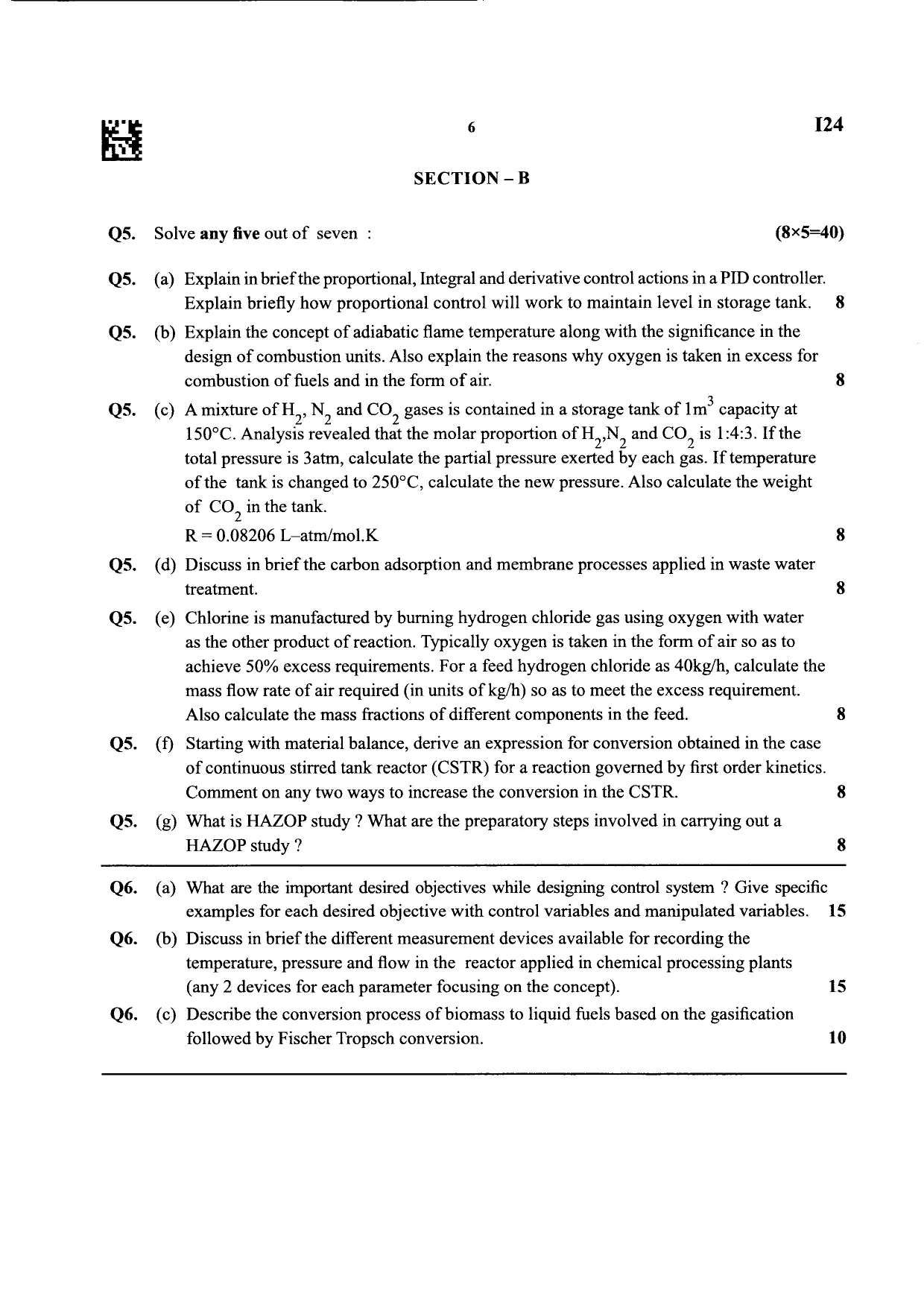
(a) Explain in briefthe proportional, Integral and derivative control actions in a PID controller.
Explain briefly how proportional control will work to maintain level in storage tank.
Q5.
:
(b) Explain the concept of adiabatic flame temperature along with the significance in the
design of combustion units. Also explain the reasons why oxygen is taken in excess for
combustion of fuels and in the form of air.
Q5.
8
8
(c) A mixture of H,, N, and CO, gases is contained in a storage tank of Im³ capacity at
is 1:4:3. If the
CO is
150°C. Analysis revealed that the molar proportion of H,N, and CO,
total pressure is 3atm, calculate the partial pressure exerted by each gas. If temperature
of the tank is changed to 250°C, calculate the new pressure. Also calculate the weight
of CO, in the tank.
R = 0.08206 L-atm/mol.K
Q5.
(d) Discuss in brief the carbon adsorption and membrane processes applied in waste water
treatment.
Q5.
8
8
(e) Chlorine is manufactured by burning hydrogen chloride gas using oxygen with water
as the other
product of reaction. Typically oxygen is taken in the form of air so as to
achieve 50% excess requirements. For a feed hydrogen chloride as 40kg/h, calculate the
mass flow rate of air
required (in units of kg/h) so as to meet the excess requirement.
Also calculate the mass fractions of different components in the feed.
8
Q5. (f) Starting with material balance, derive an expression for conversion obtained in the case
of continuous stirred tank reactor (CSTR) for a reaction governed by first order kinetics.
Comment on any two ways to increase the conversion in the CSTR.
Q5.
8
(g) What is HAZOP study? What are the preparatory steps involved in carrying out a
HAZOP study?
8
Q6.
(a) What are the important desired objectives while designing control system? Give specific
examples for each desired objective with control variables and manipulated variables. 15
Q6.
(b) Discuss in brief the different measurement devices available for recording the
temperature, pressure and flow in the reactor applied in chemical processing plants
(any 2 devices for each parameter focusing on the concept).
Q6.
(c) Describe the conversion process of biomass to liquid fuels based on the gasification
followed by Fischer Tropsch conversion.
15
10
�124
7
Q7.
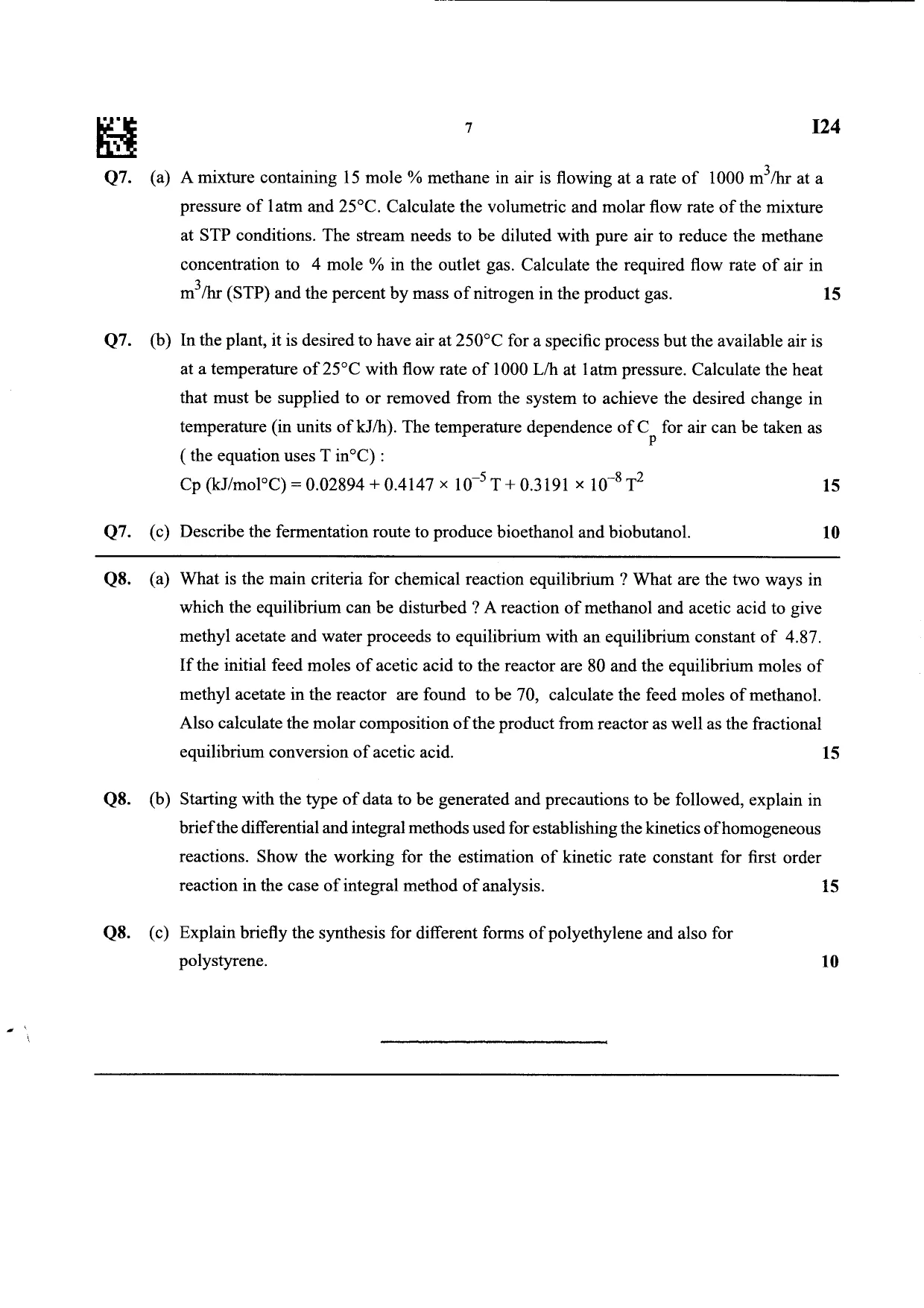
(a) A mixture containing 15 mole
% methane in air is flowing at a rate of 1000 m³/hr at a
pressure of 1atm and 25°C. Calculate the volumetric and molar flow rate of the mixture
at STP conditions. The stream needs to be diluted with pure air to reduce the methane
concentration to 4 mole % in the outlet gas. Calculate the required flow rate of air in
m³/hr (STP) and the percent by mass of nitrogen in the product gas.
Q7.
15
(b) In the plant, it is desired to have air at 250°C for a specific process but the available air is
at a temperature of 25°C with flow rate of 1000 L/h at 1atm pressure. Calculate the heat
that must be supplied to or removed from the system to achieve the desired change in
temperature (in units of kJ/h). The temperature dependence of C
(the equation uses T in°C) :
Cp (kJ/mol°C)
=
p
for air can be taken as
0.02894 +0.4147 × 10T+0.3191 × 10⁻⁸ T2
15
10
Q7.
(c) Describe the fermentation route to produce bioethanol and biobutanol.
Q8.
(a) What is the main criteria for chemical reaction equilibrium ? What are the two ways in
which the equilibrium can be disturbed? A reaction of methanol and acetic acid to give
methyl acetate and water proceeds to equilibrium with an equilibrium constant of 4.87.
If the initial feed moles of acetic acid to the reactor are 80 and the equilibrium moles of
methyl acetate in the reactor are found to be 70, calculate the feed moles of methanol.
Also calculate the molar composition of the product from reactor as well as the fractional
equilibrium conversion of acetic acid.
Q8.
15
(b) Starting with the type of data to be generated and precautions to be followed, explain in
briefthe differential and integral methods used for establishing the kinetics of homogeneous
reactions. Show the working for the estimation of kinetic rate constant for first order
reaction in the case of integral method of analysis.
Q8.
15
(c) Explain briefly the synthesis for different forms of polyethylene and also for
polystyrene.
10
�**
'AL
**
�